
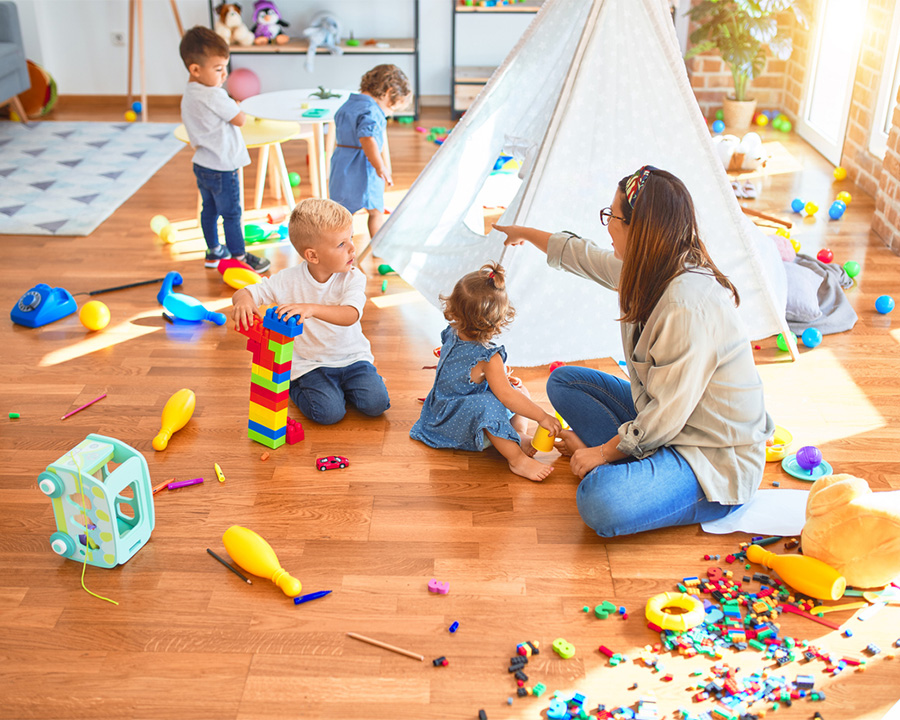
Working as an early childhood professional is very rewarding, but it can also be very stressful. Many early childhood teachers (and children) experience overwhelming and overstimulating situations throughout the day. In this blog we share 6 ways to reduce overstimulation in childcare. By implementing these strategies, you can help create a more pleasant atmosphere in your child care environment and improve the quality of children’s daily learning experiences.

What is Overstimulation?
The first step to reduce overstimulation in childcare is to understand and define the problem. Overstimulation is a feeling of sensory overload. A busy child care setting is a place filled with a plethora of sights, sounds, smells, and other sensory stimuli. Completing tasks while processing all of these sensory stimuli can be challenging for both adults and children.
Sources of Overstimulation
One of the most common sources of overstimulation mentioned by our students has been: “too many sounds.” This certainly makes sense. Just imagine how many sounds a teacher must process in a day! Doors opening and closing, toilets flushing, sinks running, toys banging and clattering, children chattering and squealing with delight, other children crying or expressing frustration, parents and other adults attempting to communicate, phones ringing, and more! Of course, a teacher cannot remove the sounds from the environment, but these 6 strategies may help reduce the feeling of overstimulation.
6 Strategies to Reduce Overstimulation in Childcare
- Set the tone with your own attitude and behavior
- Stage the environment thoughtfully
- Establish routines and expectations
- Teach the children about different volume levels
- Incorporate gentle background music or other sounds
- Create a calming corner
We will discuss each strategy in more detail in the following sections.

Reduce overstimulation by setting the tone
First and foremost, a teacher’s attitude can help set a calm, gentle tone in the child care setting. When a calm and gentle tone is set by a teacher’s attitude and manner of speaking, children will be more likely to behave calmly and gently. Of course, the children will still make joyful noises and express frustration immaturely, but consistently setting an example by communicating calmly helps children eventually learn to do so. Always remember to lead by example and to keep your cool!
Reduce overstimulation by staging the environment
If you find yourself feeling overstimulated by loud noise and activity, do not react by yelling. When you yell, that sets an example that yelling is an acceptable way to communicate in your child care setting. Some teachers use a chime or other gentle tone as a signal to get the group’s attention when there is too much noise. Others hold up a sign and walk around to be sure everyone sees it. Experiment with what signal works best for your group. Practice using that signal regularly to help children develop the habit of responding appropriately.
Carefully staging the furniture in your child care setting can help provide structure and may also reduce the feeling of being in an environment of chaos. For instance, it can help to locate your noisy learning centers like blocks, dramatic play, and music near each other. This can keep the louder sounds in one area of the room and can reserve another section of the room for more quiet activities such as reading and art.

Reduce overstimulation by establishing a routine
Establishing a routine can comfort both you, and the children. Children like to know where to go, and what is expected of them. A well established, familiar routine can reduce children’s anxiety and frustration which may also reduce their need to express their overstimulation by crying or screaming. Teach the children about your daily schedule, post a picture schedule that they can look at when they get anxious and need a reminder about when their parents will be returning.
Teach the children about boundaries and expectations in your learning centers. Help them understand that running laps, climbing, and jumping are activities that can be done outdoors, but not in the classroom.
Reduce overstimulation by establishing a routine and teaching children about volume
Sometimes children resort to running around, screaming, and throwing things because they truly do not know exactly what else to do. Many children also come to child care with limited experience playing constructively and interacting with others. They need guidance to learn how to communicate with peers, extend their attention span, and build persistence when using new materials appropriately. Act as a model or a play partner to show them how to choose a center, begin an activity, and stay engaged with that activity for several minutes.
Additionally, teach the children the difference between “loud” and “quiet” through fun interactive activities and songs. Help them learn the different volume levels that are acceptable in different locations. Demonstrate that it is fun to shout across the playground, then dramatically reduce your volume when you step back indoors. Explain that it helps everyone’s ears feel better when people use inside voices inside, and save outside voices for outside!

Reduce overstimulation in your child care setting with gentle background music
Another way to help reduce overstimulation in your child care setting is to incorporate soft background music into certain parts of your routine. Instrumental acoustic guitar or piano melodies can help create a relaxing atmosphere that inspires children to use softer voices as they interact. Different types of music bring different energy into a learning environment. Experiment with different songs until you identify a few that help you to feel at ease, but not sleepy.
Apart from that, try listening to different songs with the children in your group until you discover the best background playlist that encourages them to focus, engage, and play as calmly as possible. Some groups enjoy listening to well known children’s songs and nursery rhymes during play time. If your group prefers that, visit The Ella Jenkins website to access hundreds of children’s classics performed by Ella Jenkins, “the first lady of children’s music.” Happy listening!
Reduce overstimulation in childcare with gentle background music and a calming corner
Last but not least, a strategy that can help reduce overstimulation for both children and adults in a child care setting is creating a calming corner. In a setting with a well established routine and learning centers, a calming corner can be a place for individuals to sit or lay down, take a break, and relax. Including soft textured materials and some sensory fidget items can help those who feel overstimulated to pause, calm themselves, and become recentered by activating their other senses.
Furthermore, teaching the children the purpose of a calming corner can help them to reduce their noise and activity level near that area. Some of our students shared that they established a calming corner in their child care setting for the children to use, and ended up enjoying the comfort of that space themselves from time to time!

Want to learn more strategies to help you cope with the stress you experience as a child care provider? Take our course, Caring for Yourself and Achieving Your Goals. To learn more about how to help create a calming environment and reduce children’s stress, take our course Early Childhood Stress: Serious Stress in Children’s Lives.
Care Courses Contact
Please let us know how we can be of additional assistance! Call us: 1–800–685 7610, Monday through Friday, 9–5 ET, or email us days, evenings and weekends: info@CareCourses.com. We’re here to help!




Leave a Reply